
Defence & security industry
Air barriers for defence production halls
Large doors are part of material flow in defence manufacturing. An individually designed air barrier can limit draughts and uncontrolled air exchange while vehicles and components move freely.
Request an assessment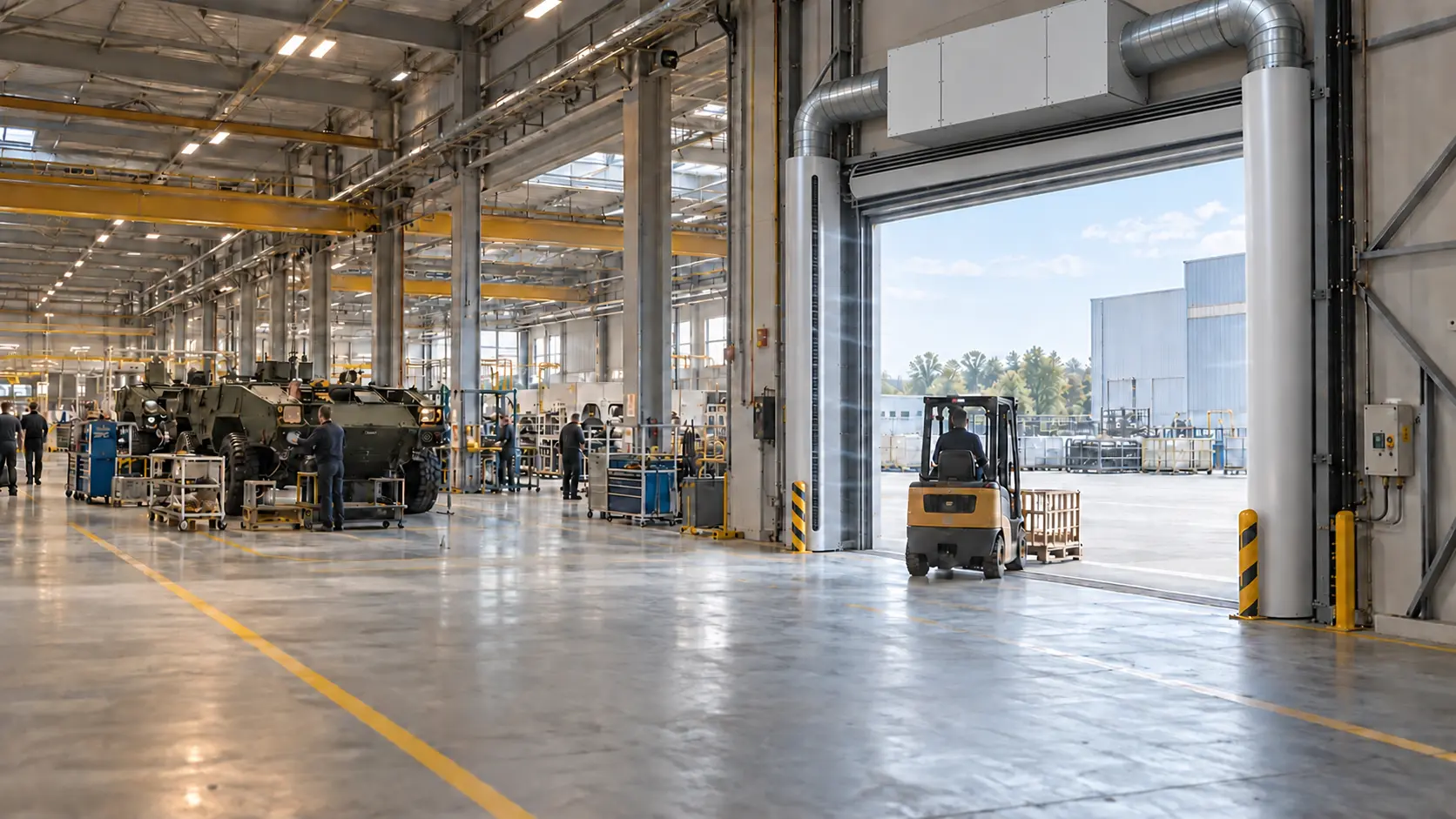
Energy first · Defence & security industry
Reduce energy losses. Assess heating and cooling demand.
Our priority is energy efficiency at open industrial doors: retaining heat in heated halls and limiting heat ingress into chilled and frozen areas. A tailored air barrier can reduce air exchange while keeping goods moving.
We assess opening times, temperatures, wind and building pressure. Draughts, hygiene and emissions are additional requirements.
Discuss ROI for your heated hallOpen routes for production
Vehicles, assemblies, components and other products move through large openings during manufacturing and assembly. When a door remains open, outdoor air can enter and conditioned hall air escapes. Workstations near the opening may be exposed to draughts.
The fan unit is positioned where the site provides suitable space, for example above or beside the door. Ductwork supplies vertical outlet columns at the sides. The directed air stream crosses the opening without obstructing transport. Performance depends on the opening, wind, building pressure and operating pattern.
Typical production interfaces
Manufacturing and assembly
Large doors used for components, vehicles and internal transport.
Goods in and dispatch
Frequently opened loading doors with people working nearby.
Between halls
Vehicle routes connecting areas with different temperatures or uses.
Start with the actual doorway
Photos, dimensions and a brief description of the process allow us to discuss a first technical assessment with arwus.
- Door dimensions and installation space
- Opening times and vehicle heights
- Temperatures, wind and building pressure
- Specific safety or process requirements